A watch is the most personal accessory you can buy — it's on your wrist through every meeting, workout, and night out. A pride watch adds a second job: wearing your colors without saying a word. Get it right and it's the piece you reach for daily for years.
Here's everything to check before buying, from case size to water ratings, plus how our pride watch collection maps to each decision.
Decision 1: Case Size (The One That Matters Most)
Case diameter decides whether a watch looks borrowed or bespoke. Most of our pride watches come in 38mm and 40mm:
- 38mm: suits wrists under 6.5 inches — reads classic and sits close to the dress-shirt cuff
- 40mm: the modern standard — balanced on most wrists without dominating them
Measure your wrist with a tape (or a strip of paper and a ruler). If you're between sizes, 40mm is the safer everyday choice; 38mm is the dressier one.
Decision 2: Water Resistance (Decode the Rating)
Water ratings confuse everyone because they're in atmospheres (ATM), not depth. The honest translation:
- 3ATM: rain, handwashing, accidental splashes — no swimming
- 5ATM: showering and shallow swimming
- 50m (5ATM): swimming and water sports
Our silicone pride watches are 3ATM — real-world proof: they handle a month of pool days fine, but take them off before diving. The stainless solar watch is rated 50m and shrugs off swim sessions entirely.
Decision 3: Movement — Quartz vs. Solar
Every watch in our collection is battery-free or near it, but the mechanisms differ:
- Quartz (standard): accurate, affordable, battery-powered — a $15–25 battery every 2–3 years
- Solar: charges from any light, never opens for a battery, runs for decades — the solar stainless model is the set-and-forget choice
If you hate maintenance, solar is worth the premium. If you rotate watches anyway, quartz is perfect.
Decision 4: Band Material (The Upgrade Path)
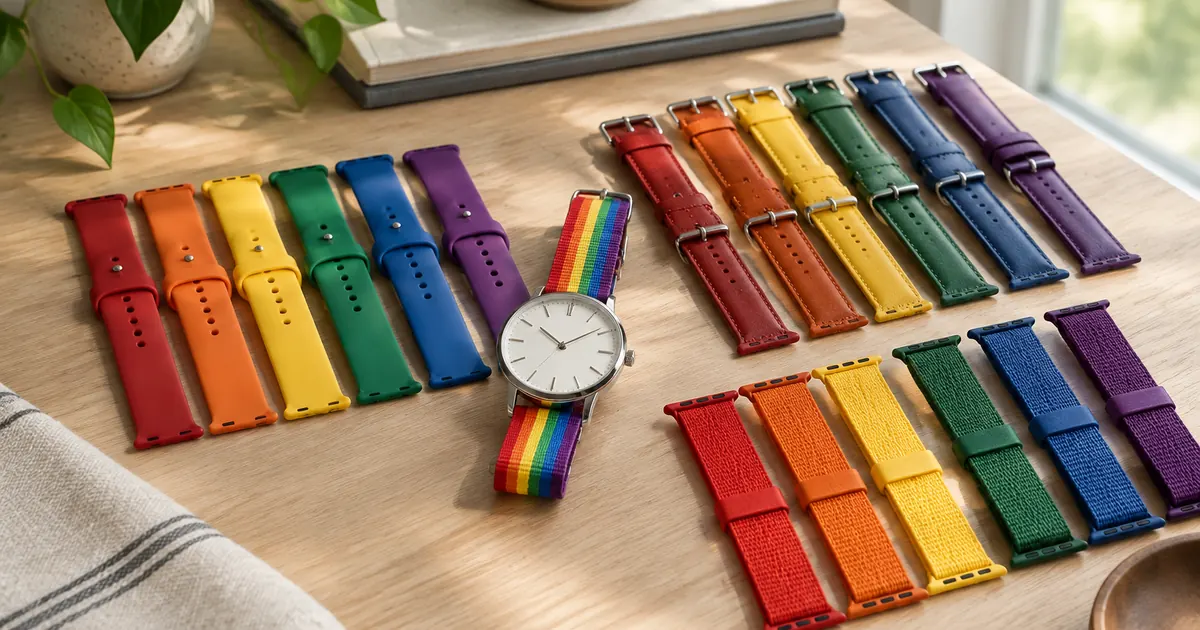
Here's the secret: the band matters more than the case for daily joy, and it's the swappable part. A 40mm pride watch on a silicone band is a gym watch; the same case on a leather rainbow band is date-night. Buy the case you like, then build a band rotation — silicone for sweat, leather for dress, NATO for adventure.
Decision 5: How Loud Should the Rainbow Be?
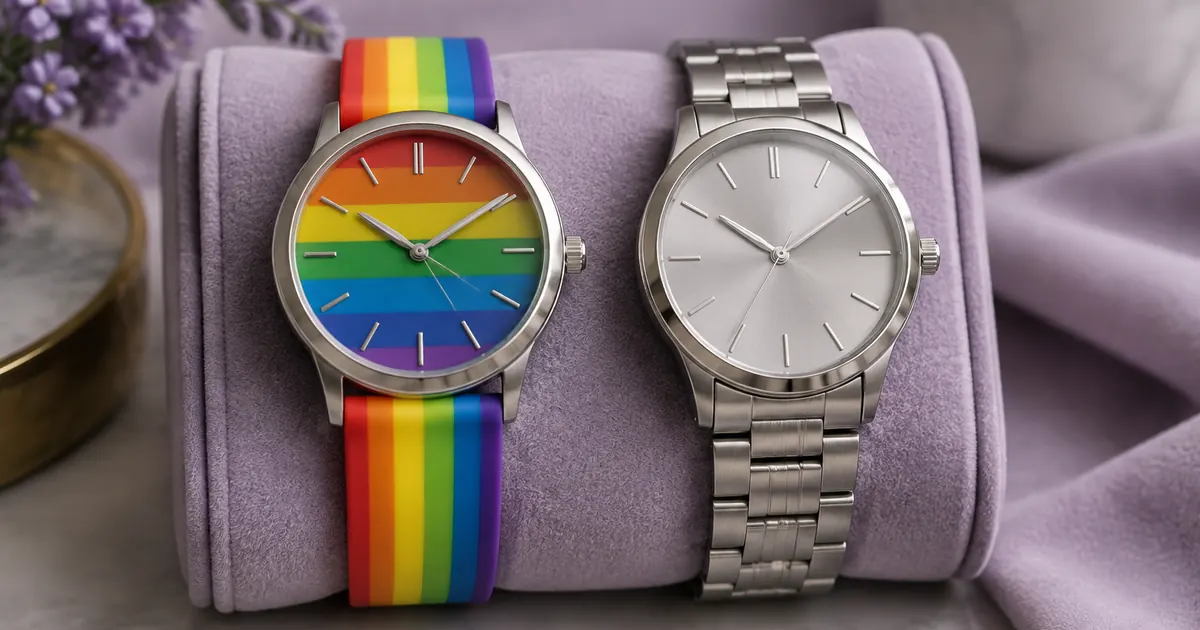
- Full spectrum: rainbow bands and dials — unmissable, joyful, and the point of the category
- Accent rainbow: a stainless case with a rainbow second hand or dial ring — pride you can explain in a meeting
- Swap-based: a minimalist watch plus a rainbow band for June — one watch, two lives
Value: What $25 Buys vs. What $89 Buys
Our silicone pride watches ($25–$38) deliver the full experience: real water resistance, quality buckles, colors that don't fade. The $89 solar stainless watch adds a metal case, sapphire-hard crystal, 50m rating, and a movement that never needs a battery. Both are honest value — the question is whether you want one watch forever or a rotation.
Crystal and Case: What to Feel For
Two physical checks tell you most of what you need about build quality. First, the crystal: tap it lightly — mineral crystal (standard at this price) sounds dull; it's fine. Second, the case weight: a stainless case should feel substantial, not hollow. Our solar model's case has the heft of a watch twice its price, which is most of why it anchors the collection.
Gifting a Watch: The Etiquette
Watches are traditional gifts in many families, and a few customs are worth knowing: present it working and set to the right time (a watch gifted "dead" is considered bad luck in some traditions); include the receipt quietly in case sizing needs a swap; and if you're unsure between two case sizes, gift the band-swap option — a watch plus a spare rainbow band covers both possibilities and makes the gift feel considered.
Strap It Right Out of the Box
Whatever watch you choose, check the fit on arrival: the band should let one finger slide between strap and wrist. Too tight strains the spring bars; too loose spins the watch face to the underside of your wrist — the most common complaint we hear, and the easiest fix. Silicone adjusts through the buckle in seconds; mesh slides its clasp; leather and nylon need a one-time hole punch or knot placement. Set it once, right, and the watch disappears on your wrist — which is exactly what you want.
The Year-One Maintenance Reality
New owners always ask what breaks first. Honest answer from our returns data: almost nothing — but what does fail is predictable. Batteries in quartz models die at month 20–30 (a $15 counter fix); leather bands worn daily without rotation crack around month 14; and spring bars on any brand fail if bands are swapped carelessly. Solar watches skip the first issue entirely, which is why we recommend them to anyone who refuses to think about maintenance. Every watch in the collection carries a 1-year warranty on top — the first year is on us.
The 60-Second Checklist
Before ordering: wrist measured (38 or 40mm), water needs known (3ATM vs 50m), movement picked (quartz vs solar), band material chosen, rainbow volume selected. That's the whole decision — browse the pride watch collection and check the boxes. Free shipping, tax free, 30-day returns if the fit's not right.